GIF animations generator gifup.com

MY FAVOURITE CARTOON AS A BOY..

Showing posts with label ARACHNIDS. Show all posts

Tuesday, April 29, 2008

STRIKE A POSE


I think she's met her match.

Grroan.
n
b
(Click photo to enlarge).

Sunday, April 13, 2008

SPIDERS, BEE-FLY AND THE MOON


Enjoying the typical April weather?
"Sunshine and showers" - the Met Office meaningless cliche eh?!

Last April, on the equivalent sunday, when the London Marathon was run (as it was today) it was 28c (82f) - a little different this year I think!
That said, the bugs and buds are responding well.

Its my birthday tomorrow, and I hope the weather will be decent enough to allow Anna and I a trip to a local wood for some Bluebell shots - fingers crossed.
(If not tomorrow, then within a fortnight I'm sure - I don't want to miss them with my camera this year!)

All the photographs above can be enlarged (as normal) by clicking on them, or use the "New Warren" link at the top page of BG to see them in their full size with explanatory text on my online photo album.
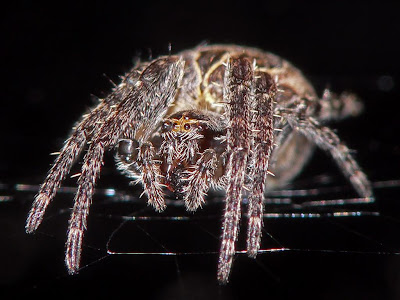
The first is a photo of the half (but waxing) moon, I took after work last night, the second is of a Bee-Fly (taken a few days ago) and the third is of a "Nursery Web spider" (taken this morning in the back garden
Want to find out more - please do visit the New Warren...

Sunday, March 09, 2008

HOSEHILL LAKE.


I'm writing this a little later than I thought. We're just recovering from a day spent in the pub yesterday, watching Anna's team win (Wales) and mine too (Scotland). What a turn up for the books - Wales could win the Grand Slam this year if they beat France next week, and Scotland could still yet win the wooden spoon, if Italy beat us next week, even though we've beaten England! I am pretty sure that event (if it happens) is rare indeed...

Annnnnyway....
On friday (gone) I took a train to a local lake, where I normally spend time watching the Peregrines and interesting Ducks - Hosehill lake (a nature reserve near Theale).
I think this was the first time I walked round this lake and hardly even looked at any birds - I was far more interested in photographing the flowers and views around the lake.

It was nice to see the Oak buds appearing. I have been worried for the past few days that we were in for an "Ash before Oak" season (you're in for a soak) rather than an "Oak before Ash" (you're in for a splash), as I'd seen the Ash buds out already.
The first large Oak I happened across though - and it had obviously been in bud for ar least as long as the Ash.
I've posted a picture of a "Marble Gall" on an Oak branch below. This was made last summer by a single female parasitic wasp, but it hs been deserted for months now, and turned quite woody.

I think we have something to the tune of 90 or so different types of Galls and Gall Wasps in the UK - and around half of those are found only on Oak trees.

I also think friday was the first day that all the midges hatched in huge numbers. I really could have done with some "Jungle Formula" walking around the lake - but I very much enjoyed watching some spiders "make hay" with these chironomid midges.
The Zebra spider I photographed above had just finished her meal of midge when I took her photograph.

It was also nice to try and learn a little more about our wild flowers which are now popping out of the ground all over the place - that book I bought t'other day is really coming in handy now! I fully admit my knowledge of flowers and plants is pretty abysmal - I've stepped on them for as long as I can remember, but am starting to really appreciate them now...

Finally - I thought I'd take some photographs of a grazing horse, which seemed very happy to follow me around. I like the photograph so much (above), that I'm thinking of printing it up nicely, and asking the horse's owner (who I don't know) if they'd like to buy it off me! What have I got to lose eh?!

Anyhoo - click on any of the photographs above to enlarge, as normal... AND click HERE to see more of my Hosehill lake photographs (and others) in the "New Warren" online photo album.

Friday, February 29, 2008

FOLIAGE SPIDER AND A FEW THOUGHTS...


Two days ago, our overwintering Chiffchaff (the one that's been here all season with his white primary feather) started to sing for the first time in 2008.
It was a sound Anna and I got used to during last spring and summer - but I hadn't heard him utter a peep since last autumn.
Early yes - but cheating a bit, as I know he's not flown south for the winter.

On that sort of subject, I can see that the winter Goldfinch flocks have yet to break up yet, nor have the winter flocks of Long-Tailed Tits. Won't be long now though...

What about our Blue Tits - Brittany and her mate?
Slightly worrying news I'm afraid to report.
I'm well aware that I haven't uploaded any recent nestbox videos in the past fortnight or so.
For two reasons - firstly I've been extremely busy, and secondly, because I've hardly seen them anywhere NEAR the box. In fact, I've hardly seen them at all, and am not convinced they are both still alive - but they might well be.
I'm pretty sure the male is alive - I occasionally hear him calling.
Time will tell of course, though I was rather hoping that in about 2 weeks, (like last year), they'd be stating to put nesting material into the box.
Maybe someone down the road has put up a more desirable nestbox than us?
I do hope they are (BOTH) still alive, and are just taking a break....

Keep your eyes open on the roads at present.
I took a phonecall the other day from a lady in Northern Ireland, reporting hundreds of dead frogs on a road near a lake.
Pretty normal in February and early March I'm afraid.
I saw it myself t'other day, on a road in Berkshire - lots of frogs squashed on a short stretch of road, with the spawn literally forced out of them in some cases - not a particularly aesthetically-pleasing sight.
Lots of amphibians are now involved in migration back to their place of birth (or as near as dammit), to spawn this year.


Now - the "Foliage Spider".
Apologies for the poor quality of the two photographs above.
I took them last night, in the dark, and I should tell you the spider was about 12' up our exterior kitchen wall, and we've got no ladder.
It certainly is some kind of male "Foliage Spider" (a Clubiona sp.) but there are about 19 species of this genus of spider in Britain - and I couldn't possibly narrow it down further than the genus from these poor photographs.
I have a suspicion its Clubiona reclusa but I can't be sure.

Most Foliage Spiders look very similar. Elongated abdomens, fine brown hair (almost like fur) covering their abdomen and cephalothorax, with long spinnerets at the rear.
They normally dwell in foliage (as their name suggests), or under stones on the ground, behind tree bark, or in gaps in fences - weaving a silk retreat purse if you will, in which they lie during the daylight hours.
Come night time though, and they're on the prowl - they are hunting spiders, and don't make webs as such.

I assume this one (a male - see his club-like pedipalps) maybe lives in a gap in our wooden fence, or in a little spot under the gutter for example.
I don't suppose we'll see him on the bare wall that often.

As a rough scale of size, I'd say he was just under one inch long - so hardly a monster, but not really that small.
I'll try and get a better photograph of this genus of spiders as and when, in more ideal photography condusive circumstances, but for now, click either image to enlarge...

Wednesday, February 27, 2008

GO ON THEN. ONE MORE...


This is now the THIRD species of "Jumping Spider" I've photographed this week.

Along with my "House Jumping Spider" in the spare bedroom, and my "Fence-Post Jumper" on the Blue Tit box, I've now re-found this little lady, hunting on our back gate, in the warm sun today.

This, of course, is the most famous Jumping Spider in Britain - the "Zebra Spider", Salticus scenicus, and this indivdual is once again, a small female (no HUGE chelicerae (fangs) on her like the Zebra Spider males), at about 2-3mm high and 4mm long.

I've gone into this species' biology before, so no need to again, but do click on any of the above images to enlarge them...
I've added the best to the "New Warren" and enlarged it MUCH larger if you'd like to take a look HERE.

Tuesday, February 26, 2008

TALKING OF SPIDERS... ANOTHER OF MY FENCE-POST JUMPERS...


They ALL want their photographs taken now...

This little "byoody" (as the late Steve Irwin might have said), I've just this second photographed on the front of the nestbox.
(The pale clour behind her is the circular nest box entrance hole for the Blue Tits...).
I think she's safe at present though - our Blue Tits only seem to visi the box in the morning.

Click, as always, to enlarge.

SHE WON'T LEAVE ME ALONE...


As I uploaded all my photographs into the New Warren, my little lady friend reappeared next to the computer on the window frame.
She seems intent on having her photo taken now - fickle eh?
This, of course, is the female "House Jumping Spider" I chased around our ceiling a few days ago...
Anyway - couldn't resist.
Click to enlarge.

Wednesday, February 20, 2008

Pseudeuophrys lanigera "THE HOUSE JUMPING SPIDER"


I always thought this was called the "Wall jumping spider", but after a little research, it seems like it has no common name - just Pseudeuophrys lanigera.

I found this on our hall ceiling this morning, and its taken me an hour or so to get a few half decent shots of it.

I'll add to this post when I can, after finding out more about this tiny wee jumping spider - about 4mm in length and 3mm in width.
Click any image to enlarge...
b
b
NB. Later today.
After some more research I have found that this spider is one of eleven species found within this genus in Europe. Our spider is a female (its fore legs are not darkened - as is the normal colouration for displaying males), and it does have a common name - the "House Jumping Spider". It is very often found near or in human habitations - often on or in roofs, and sometimes in rooms - like the one I photographed.

Friday, February 08, 2008

"BUG LIFE" BLOSSOMS TODAY


Its been glorious here in the south of England today - beautiful blue skies and I think a temperature of about 14c - not bad for early February!

Thus, today was the first day that the wee beasties came out to play in the garden.

I'm working nights at the moment, and haven't gone to bed yet, because of all the life in the garden to take photographs of...!
I've had cluster flies, hoverflies (drone flies), bluebottles, ants, ladybirds and spiders.

I'll just post 4 photographs on BG though (and not upload them to the New Warren (my online photo album - I'm dog-tired and think I can do better) - 3 of another "jumping spider", the "Zebra Spider" (Salticus scenicus), a bolder, brasher, brighter, more famous version of its cousin, the "Fence Post Jumper" (Marpissa muscosca). The Zebra Spider is more likely to bite you than the Fence-Post Jumper, and it may hurt a bit (a bit like a sting). It has MUCH larger fangs *chelicerae) if its a male, than its cousin, although these are almost invariably hidden behind its pedipalps. You'd have to really go some though, in order to provoke one of these to bite you.
The scenicus part of their scientific name literally means "actor" - quite apt I suppose - these are entertaining wee spiders...
This one was a very small example of a female (small chelicerae) though - no more than 4 or 5mm long.

The last photo is of a Pine Ladybird - sometimes called a 4 spot ladybird. It is smaller than many ladybirds (obviously early to appear though), black, with a noticeable rim around its elytra, and 4 red smudges. Some say the front 2 smudges look like commas, I think the four smudges look like 2 red ducks watching two red feathers floating down towards them.
Yes. I know. The men in white coats haven't quite caught up with me yet...
The Pine Ladybird is a hardy beastie. It often starts mating in warm days in mid February, like today, and lives on many trees - not just pines. It is certainly noted for eating Scale insects which dwell on Urban Lime trees - like the one behind our fence. It very possibly is the most adaptable (native!) Ladybird in the UK.

Click any of the images above to enlarge.
What a glorious sunny day! Right. I'm off to bed...

Sunday, February 03, 2008

AMAUROBIUS SIMILIS (THE "INDOOR FUNNEL WEB / LACE WEAVER")

Please DO click to enlarge!
I've posted about this species of spider before.
About the size of a 2p piece - includng its legs.
I got this one to stop in my usual way, by shouting at it to do so.
More details in my " New Warren" photo album.


Saturday, January 19, 2008

FENCE-POST WOODPECKERS & FENCE-POST JUMPERS


Fence-post jumpers above.

Fence-post woodpeckers below...

GREAT NEWS!
After 8 weeks or so, our "woodpecker-attracting fence-post" has finally come good!
No pictures (YET) I'm afraid, but about 30 minutes ago, Anna and I were treated to the brief sight of a Male Great Spotted Woopecker, on our suety-nutty 8'post. BRILLIANT!
The female was in the Lime tree at the same time also.

The only reason I didn't get a photo, was because within about 30 seconds after he hopped along the gate, checked out the band of red paint (to attract them) and got on the feeder proper, along came one of the 6 or so (thats all) daily cars along the service road, t'other side of the fence. Talk about bad timing!

Actually, I did get a shot, but it is so bad - I'll not post it unless I have to (ie they never return - and I cannot see that happening).

So - eight weeks of NOTHING - then two at once, and over so soon, because of one dozy car.
Grrrrrr!

I will top up the post with suet and nuts and remain vigilant, with camera poised....
They'll be back. I promise...!


As for the Fence-post jumpers.
Well, you know what those are.
I had a little exploration of my old green t-shirt which was left on the ground by the back wall of the house over the autumn and winter.
Lovely to find (at least) 3 Fence-Post jumper "lairs", and I took the opportunity to snap a few photographs of my favourite spiders...
Click to enlarge any of the above images...

Friday, January 18, 2008

MALE FUNNEL WEB / LACE WEAVER SPIDER


Should I rename BG the Spider Blog?!

I am enjoying taking photographs of these fascinating beasties though, and at present, there's not much else for me to photograph with the hours I'm keeping (because of work) or the time of year.

This one I photographed on the office window last night.
Another (male -note the "long-armed boxing-gloves") Funnel Web Spider (or Lace Weaver), on the nocturnal prowl.
It is certainly (like the other Funnel Web Spider I shot on the house), an Amaurobius sp. either A. fenestralis or A.similis, though your guess is as good as mine which.

It should be an A. fenestralis, (latin name derived from the fact it is often seen on windows), but I happen to think its an A.similis, like the one at home. To be honest, there's quite confusing identification guides with these two british Funnel-Web Spiders, so I'll just call it that then eh, a Funnel Web Spider or Lace Weaver, reknowned for their blue-tinged lacey webs...
This male was no more than an inch long (and wide) INCLUDING its legs.

Thursday, January 17, 2008

MUMMY LONG LEGS

Click on photo to enlarge.

The mother (quite literally) of "Daddy Long-Legs spiders" just ster-rolled in through the back door this morning.

SOooo... I took (yet another) shot of it (her) ambling down the hall. Note the small pedipalps (or one you can see anway (- at the front of the head)) and the much better view of her eyes in this shot.

This individual is about 20x the size of the first "DLLS" I took a shot of in the kitchen, and I'd say at least double the size of the male under the bathroom sink.

HYOWGE.


Wednesday, January 16, 2008

MALE "MONEY SPIDER"


This 3mm long spider was sitting on our kitchen ceiling tonight.

Commonly known (at least in Britain) as a "Money Spider" (as if it runs around your hand, legend has it that it's spinning you new clothes, meaning financial wealth), it is more often known worldwide as a "Sheet weaver" or a Lyniphid spider.
The Lyniphids are over 550 genera strong, with over 4300 species identified world wide, and probably more than that still to be identified. You'll therefore forgive me, I'm sure if I just call our Lyniphid spider, a Money Spider, and leave it at that!

Monday, January 14, 2008

FEMALE "BRIDGE SPIDER" (2)


I'll be quick with this one, as I know how you all lurrrve spiders!

Photographed this beauty on the side of the office last night.

This is Larinioides sclopetarius, more commonly known as the "Bridge Spider" because of its preferred habitat of metal structures close to water.

Walk along a river or canal with railings - THIS is the spider that will be building its orb webs between those railings, or on the bridges, or even around the lamposts nearby- they seem to LOVE lamposts - not surprising really, as when the sun goes down, these nocturnal spiders come out, and with a web under a street light (near water remember), they are pretty well guuaranteed a feast most nights eh?

It has been recently noticed that this spider is getting rather fond of Greenhouses too, especially near ponds, be they in back gardens, or garden centres.

This seems to me to be a very sensible species of spider.

In case you weren't sure my office (at present) sits on the top floor, overlooking the river Thames - and in the summer, the floor-ceiling windows (on the outside at least) are CRAWLING with these Bridge Spiders.

Click HERE to revisit my first post on this species of spider, in May of last year.

NB.
I'm not overly impressed with the photo. It will magically change when I capture a better one...


18/01/08 - a different angle of my Female Bridge Spider, showing her eyes a little better, and one of her cheliceral fangs, through which she'll inject paralysing venom into her prey.

Sunday, January 13, 2008

MALE DADDY LONG-LEGS SPIDER

Click to enlarge.

Note the enlarged pedipalps (look like boxing gloves) with which the male waves in a semaphore fashion when "courting" his prospective mate, and then with which he presents that mate his sperm.


If he is lucky...


FEMALE "MISSING SECTOR ORB WEAVER" (2)


Click to enlarge

WINTER SPIDERS

I will eventually stop apologising for posting about spiders at the moment!
I've been noticing more and more of the Missing sector Orb Weavers, Zygiella x-notata spiders around recently. Those, and the Daddy Long-legs spiders, Pholcus phalangioides, in the house (well, one or two anyway).

The MSOWs are amazing in that unlike most other spiders, the female of the species tends to build their very distinctive webs all year round.
I noted a dozen or so webs yesterday, all with a female on it, and all missing a sector at the top of the orb web, with just one thick, "signal thread" through this missing sector, to the centre of the web proper.

Spiders are fascinating in my opinion.
Not only is their basic leg movement pretty well governed by hydraulics - they effectively pump fluid into their hollow legs to extend them, and use a simple muscular arrangement to bend the leg back towards the body, expelling the fluid inside - exactly like a hydraulic piston - at incredible speeds when one thinks about it.
The next time you watch a House Spider race across the floor - think about its movement in terms of hydraulics - thats pretty darn impressive in my eyes.

Not only that, there is the silk they produce.
Spiders' silk is five times stronger than steel, and thirty times stretchier than nylon.
Your average spider will spin more than 4 miles of silk in its lifetime.

Most spiders are expert web builders, even in zero gravity conditions. (Its amazing what scientists research sometimes....).
Give a spider some drugs though, and its ability to construct a decent web is impaired.
Give a spider some marijuana, (I don't know whether you can get a spider to smoke), and the spider will lose concentration have way through building a web, and leave it half-done.
Give it amphetamines - and the spider will spin faster, but with FAR less accuracy.
Give the spider coffee though, and the web-building process is most seriously impaired. In this case, the spider will just produce a random pattern of just a few threads stuck together, pretty haphazardly.
The first two resuts of drugs and spiders experiments are hardly surprising eh? The coffee experiment surprises me though...

I'll post a photograph of another Missing Sector Orb Weaver on its web above, showing its missing sector, and its signal thread above, so readers of BG can click to enlarge.

Above that, I'll post a photograph of a male Daddy Long Legs spider (with its "boxing glove" pedipalps) that I took this morning, under our bathroom sink. Once again, click on that to enlarge...

Saturday, January 05, 2008

MISSING SECTOR ORB WEAVER


Click to enlarge

Yep.
ANOTHER Spider, for all you arachnaphobes. I'm sorry!
This one I found in the dining room yesterday.

Its common name is the "Missing sector spider" (Zygiella x-notata). It can be recognised by the fact it is invariably found near human habitiation, often in window frames or strangely enough, boat-yards? (I don't know either)! It is small, has a brown, almost translucent cephalothorax (with fine hairs like a comb-over), and a distinctive leaf pattern on is brown (or pink in our case) furry abdomen.


It is very common, and is active in the colder months too thanks to its affinity with human habitation. (It does prefer the warmth of summer, which it gets all year round thanks to our homes).

Its called the Missing Sector Orb Weaver because of its very characteristic web pattern - with a sector missing in the top corner, along which runs a "signal thread". The spider often sits out of sight, with its 2 long front legs on this thread. You can guess what happens next... Zygiella sp web, image courtesy of wikipedia

Thursday, December 27, 2007

FEMALE FENCE-POST JUMPER

Click to enlarge.


Finally - what I really bought my new camera for! Its been unseasonably mild here today - the spiders are out again, as is the odd Queen Bee I hear.


I snuck up on this Fence-Post Jumper, last posted about in April, and snapped it on my old fleece near the birdbox.
Remember. This spider is about the same size as a pea!